
What are Flock cameras used for? What a Flock camera is and does
Police mainly use Flock cameras to find stolen vehicles and wanted or missing people, and to search past images in investigations. Sourced uses and specs.
Updated Nov 12, 2026 · data refreshed daily · corrections
A Flock camera is a solar-powered, cellular-connected automated license-plate reader (ALPR) made by Flock Safety. It photographs vehicles that pass, reads the plate and other vehicle details, and lets the customer, usually a police department, search the images and get alerts. Flock's spec sheet lists the plate camera at about 8.75 × 5 × 2.9 inches and 3 lbs, and it typically sits on a black pole next to a small solar panel (Long Grove, IL document, USA Today). Below: what Flock cameras are used for, specs, what it looks like, what it records, and a Flock camera near me. More: Flock camera FAQ, how to spot one, who owns and pays for them, and the court cases.
What Flock cameras are used for
Police mainly use Flock cameras to find vehicles: stolen cars and plates, vehicles linked to wanted or missing people, and vehicles seen near crimes. Flock says businesses, neighborhoods and schools also use them for security (Flock). Each use below has its source.
- Stolen vehicles and plates. Agencies get an alert when a plate on a stolen-vehicle list passes a camera (Bedford, TX, Flock). In June 2026, Richfield, MN's cameras generated 14 stolen-vehicle alerts and 7 stolen-plate alerts (Richfield FAQ).
- Wanted people and warrants. Hot lists can include wanted persons, warrants, protection orders and officer-safety alerts (Richfield FAQ). Flock says alerts can match a customer-defined list or an NCIC hot list (Flock).
- Missing and endangered people, including AMBER Alerts. Bedford, TX says its system checks national alerts, including AMBER Alerts for abducted children, Silver Alerts for missing senior citizens and Blue Alerts involving threats to law enforcement (Bedford, TX). In a post published May 21, 2021, Flock said it had joined the National Center for Missing & Exploited Children's AMBER Alert Secondary Dissemination System so agencies can receive automatic alerts on vehicles tied to an active AMBER Alert (Flock).
- Investigating crimes after the fact. Investigators search past images for a plate or a vehicle description. Bedford, TX says its searches go back 30 days (Bedford, TX). Richfield, MN police say the cameras have assisted homicide, robbery and burglary investigations, but they also say this doesn't prove Flock reduced crime or raised convictions (Richfield FAQ).
- Driver's-license status alerts, where a state list supplies them. Richfield, MN reported 12,928 alerts against the Minnesota hot list in June 2026. The city said the overwhelming majority were about driver's-license status (9,868 revoked and 2,653 suspended), and that an alert doesn't mean an arrest, citation or stop occurred (Richfield FAQ).
- Private security. Flock says its readers are used by law enforcement agencies, businesses, neighborhoods, apartment complexes, houses of worship and schools (Flock). Flock says HOAs typically place them at neighborhood entrances and exits (Flock).
What they're not for, and the limits
A Flock presentation says the system is "NOT used for traffic enforcement" (Contra Costa County packet), and Bedford, TX police say they don't use theirs for immigration enforcement or speed enforcement (Bedford, TX). Those are agency and company statements, and policies differ by town. Stoughton, MA police call a hit "only a lead" that needs more investigation (Stoughton PD), and Richfield says an alert is not automatic authority to stop a vehicle (Richfield FAQ). To learn how your own town uses its cameras, request its policy, sharing list and audit logs. For documented problems, see our misuse tracker, and for tickets, video and retention, the Flock camera FAQ.
Flock camera specs
These figures are what Flock listed on a "tech specs" exhibit in a Long Grove, IL village document and in a Warrenton, VA council presentation dated Sept. 9, 2025. The Long Grove exhibit itself is undated (installation drawings in the same file show revision dates of June 9, 2020 and Oct. 26, 2020), and Flock has changed models since, so treat them as examples of one generation of hardware.
| Camera size and weight | 8.75" long × 5" high × 2.875" wide, 3 lbs (spec sheet) |
|---|---|
| Mounting | Adjustable band clamps, on a pole top or the side of an existing pole (spec sheet) |
| Connection | Uploads via integrated LTE (cellular) (spec sheet) |
| Power | Dual solar panels, 18-20V, about 25.7 lbs with hardware, 21.25" × 28"; an electric option on an existing pole is also listed (spec sheet) |
| Flock pole | DOT breakaway pole, 12 ft installed height, black-coated 6061 aluminum, 2.875" outer diameter (spec sheet) |
| Field of view | The sheet lists "15' wide, 65 distance" (units as printed) (spec sheet) |
| Range and speed | Falcon standard range: 25-45 ft, up to 80 mph, 2 lanes. Falcon short range: 10-25 ft, 2 lanes (Warrenton, VA presentation) |
| Assembly | Flock Safety, Atlanta, GA, per the sheet (spec sheet) |
| Current lineup | Flock lists LPR Pro, Standard, Wide-Range, Long-Range and Flex LPR cameras, plus LPR trailers (Flock) |
What it captures
Still images, plus machine-learning tags that a Tukwila, WA FAQ calls Vehicle Fingerprint (Flock's current license-plate-reader page also calls this feature Vehicle Signature): make, body type, color, plate state and type, missing plates, and "other identifiers (roof rack, window stickers, toolbox, and more)" (Tukwila, WA FAQ). That lets users search for a car without its plate number (EFF). Flock's product page says facial recognition is "not included" in its LPR product (Flock); that is Flock's statement, and we haven't independently tested it.
What a Flock camera looks like
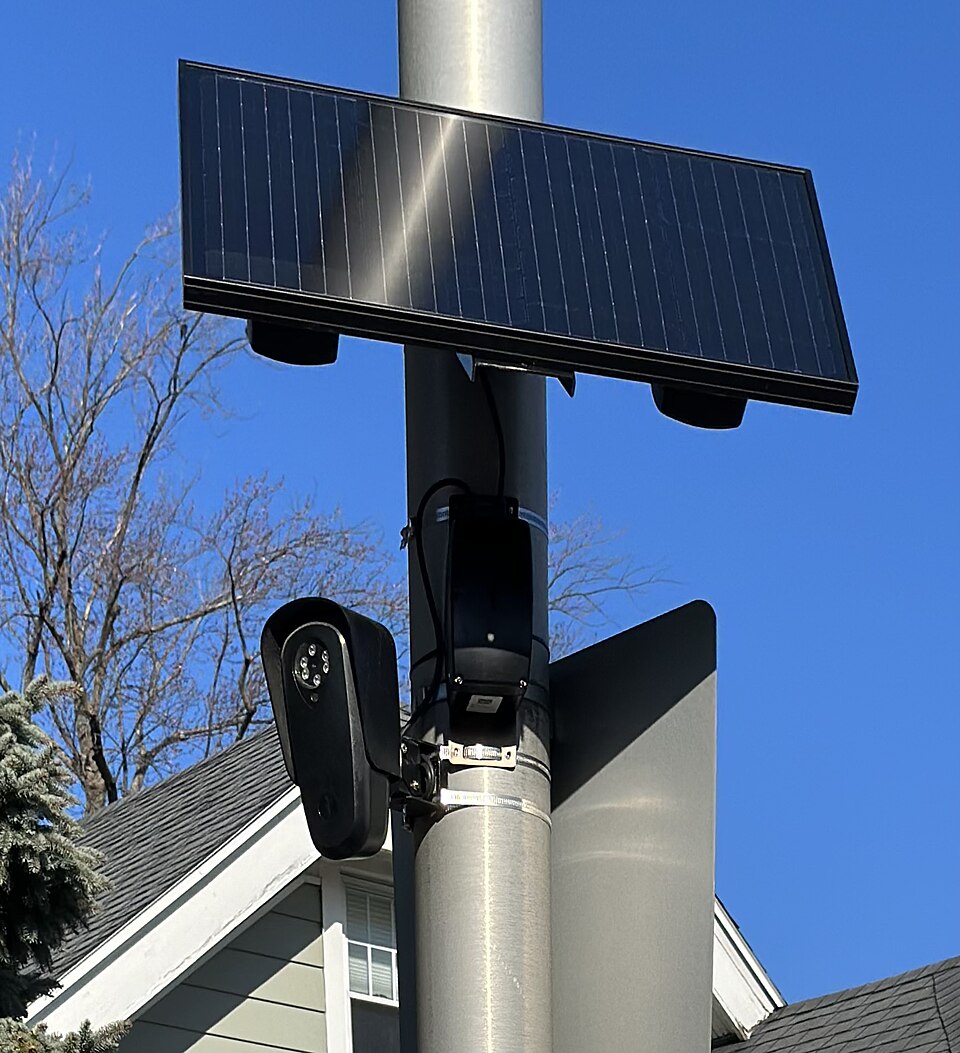
USA Today says they're typically on a black pole with a camera on one side and a solar panel on the other, along highways, near intersections or on busy roads, and that some Flock models look more like regular security cameras (USA Today). Our spotting guide shows where to look.
How many there are
Flock doesn't publish locations. In our OpenStreetMap snapshot of Nov 22, 2026, volunteers had reported 146,603 license-plate readers in the US, 116,617 of them tagged Flock Safety. Every one is reported, not verified. Look up a Flock camera near me or open the Flock camera map.
Who owns and pays for them
Under Flock's terms the customer owns the data and Flock keeps title to licensed hardware, and public contracts show prices starting around $3,000 per camera per year plus installation. Dates, amounts and sources are in who owns Flock cameras and who pays for them.
How long data is kept
Flock says its default was 30 days unless state or local policy says otherwise, and it now recommends 7 days for new setups. Some states set limits by law (ALPR laws by state).
Are Flock cameras legal?
Generally yes, but state rules differ. In January 2026 a federal court granted Norfolk, VA summary judgment in a Fourth Amendment challenge to its Flock cameras (order), and the plaintiffs appealed. On Oct. 1, 2026, a federal judge in Oklahoma held that one deputy's warrantless search of a month of a driver's Flock history was unconstitutional (U.S. v. Kyle). That ruling binds only that case, and most courts have ruled the other way (The Ruling Desk). See all the cases and your state's law.
General information, not legal advice.
Frequently asked questions
What is a Flock camera?
A Flock camera is a solar-powered, cellular-connected automated license-plate reader (ALPR) sold by Flock Safety, an Atlanta-based company. It photographs passing vehicles, reads the plate, and lets the customer (a police department, HOA or business) search the images and get alerts when a plate on a hot list passes, per Flock materials and agency FAQs such as Stoughton, MA's.
What are the specs of a Flock camera?
A Flock spec sheet in a Long Grove, IL village document lists the plate camera at 8.75 by 5 by 2.875 inches and 3 lbs, mounted with adjustable band clamps and uploading over integrated LTE, with dual solar panels (18-20V, about 25.7 lbs with hardware) and a 12-foot black aluminum breakaway pole. A Warrenton, VA council presentation lists a standard-range Falcon at 25 to 45 feet range, up to 80 mph and 2 lanes, and a short-range Falcon at 10 to 25 feet and 2 lanes. Models and specs change, so treat these as examples.
What does a Flock camera look like?
Usually a small camera on a black pole, with a solar panel on the other side. Flock's spec sheet lists the plate camera at about 8.75 by 5 by 2.9 inches and 3 lbs. USA Today describes them as typically at the top of a black pole with the camera on one side and a solar panel on the other, near intersections and busy roads, and says some models look more like regular security cameras.
What are Flock cameras used for?
Police use them to find vehicles. Agencies get an alert when a passing plate matches a hot list, such as stolen vehicles or plates, wanted people, or missing or endangered people, and they search past images when investigating crimes. Flock says HOAs, businesses and schools use them for security. In June 2026 the Richfield, MN police department reported 12,928 hot-list alerts, the overwhelming majority about driver's-license status. Stoughton, MA police call a hit "only a lead" that needs more investigation, and a Flock presentation says the system is "NOT used for traffic enforcement."
Are Flock cameras used to find missing children?
They can be. In a post published May 21, 2021, Flock said it had joined the National Center for Missing & Exploited Children's AMBER Alert Secondary Dissemination System, so agencies can receive automatic alerts on vehicles tied to an active AMBER Alert. Bedford, TX says its system checks national alerts including AMBER Alerts, Silver Alerts for missing senior citizens and Blue Alerts. An alert is a lead for officers to verify, not a guarantee that anyone is found.
Do Flock cameras catch speeders or give traffic tickets?
Not according to the agencies and Flock materials we found. A Stoughton, MA police FAQ says it is not designed to detect traffic violations and send citations, and a Flock presentation says it is "NOT used for traffic enforcement." Bedford, TX police say they don't use theirs for speed enforcement. Policies differ by agency, so check your town's.
What does a Flock camera capture?
Still images of passing vehicles, plus machine-learning tags that a Tukwila, WA FAQ calls Vehicle Fingerprint (Flock's current license-plate-reader page also calls this feature Vehicle Signature): make, body type, color, plate state and type, missing plates, and items like roof racks, window stickers and toolboxes, per that FAQ. A Flock presentation in a Contra Costa County packet says the system is not connected to DMV registration data.
How many Flock cameras are there?
Flock doesn't publish a location list. In our OpenStreetMap snapshot of Nov 22, 2026, volunteers had reported 146,603 license-plate readers in the US, 116,617 of them tagged as Flock Safety. These are reported, not verified, and real totals may be higher.
Who owns Flock cameras, and what do they cost?
Under Flock's terms, the company keeps title to licensed camera hardware and the customer owns the data. Public contracts we reviewed show prices starting around $3,000 per camera per year plus installation. Our guide to who owns Flock cameras and who pays for them has the dated sources.
How long does Flock keep data?
Flock says its default retention was 30 days unless state or local rules set another period, and it now recommends 7 days for new setups. Data saved as evidence can be kept longer.
Are Flock cameras legal?
Generally yes, with limits that vary by state. Most courts so far have held that ALPR use isn't a Fourth Amendment search; for example, a federal court upheld Norfolk, VA's Flock system in January 2026 (now on appeal). On Oct. 1, 2026, a federal judge in Oklahoma ruled one deputy's warrantless Flock search unconstitutional in United States v. Kyle, a ruling that binds only that case. Some states, such as New Hampshire and Washington, restrict use or retention by statute. This is general information, not legal advice.